Mitka the Cuckoo
The Painted BirdMitka the Cuckoo is at once a celebrated Soviet sniper, a patient caretaker, and a mentor who shapes the narrator’s understanding of courage. His story turns on the gap between public honor and private obligation: though a bullet wound has ended his work as a sniper, he eventually acts on his own judgment of what justice requires, risking the very reputation that made him a hero.
Identity and Military Background
Mitka serves in the regiment as a sharpshooting instructor and is known both as Mitka the Cuckoo and, later, Mitka the Master. His reputation rests on a distinguished military record. He is a Hero of the Soviet Union, the highest military honor, and one of the most decorated men in the division. His achievements are familiar beyond the regiment: newspapers and books recount his actions, newsreels show him to millions, and correspondents interview him. Soldiers, in turn, revisit stories of his dangerous missions behind German lines, where he parachuted in alone and used his marksmanship against officers and couriers of the German Army.
The public image is sustained by objects and ritual as well as stories. Soldiers admire Mitka’s rifle, and he handles it with care, removing it from its sheath and inspecting its sights and stock. Its telescopic sight represents the skill that made his name: the distant enemy could be brought close enough for a deliberate shot. The weapon is not merely a trophy. It embodies a vocation that Mitka can no longer practice as he once did, and the reverence it receives makes his loss visible even before he speaks of it.
Care and Mentorship
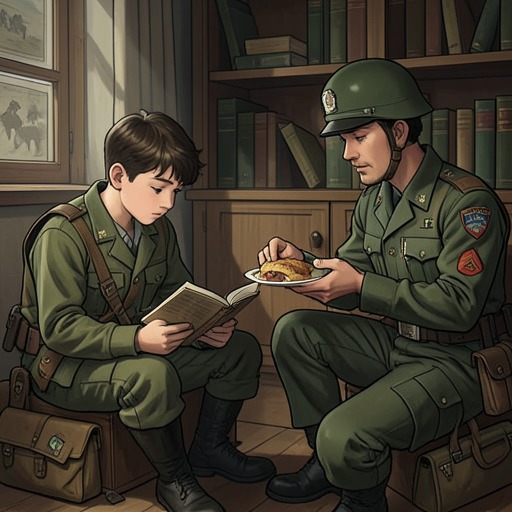
Mitka has looked after the narrator since the boy entered the regimental hospital. His care is practical and sustained. He chooses the best pieces of meat from the caldron and skims fat from the soup for him; when the narrator becomes ill after overeating, Mitka stays beside him for two days, holding his head when he vomits and wiping his face with a wet cloth. He also helps him face painful injections and medical examinations. The narrator gains weight under his care, but the relationship gives him more than food and physical protection: Mitka makes a place for him among the soldiers.
The two men teach the boy different kinds of knowledge. Red Army mentor Gavrila spends time with him in the field library, teaches him to read, and explains the role of the Party. Mitka opens other doors: he introduces him to poetry, sings with guitar accompaniment, takes him to the regimental cinema and explains the films, and shows him truck mechanics and sharpshooters in training. Together, these forms of instruction make the regiment a school as well as a military community. Mitka’s attention helps the narrator imagine himself not as a child to be dismissed, but as someone who might one day earn a place among the soldiers.
That possibility becomes a personal ambition. Listening to stories of Mitka’s exploits, the narrator sits beside him, leaning on his arm, and imagines becoming a sharpshooter if the war lasts until he is old enough to serve. Mitka’s example gives military skill an intimate meaning: heroism is not only something printed in newspapers, but a practice the boy watches at close range and hopes to learn.
Injury and the Loss of His Former Role
The rifle’s admiration also recalls what Mitka has lost. A year before the regiment’s present life, a German bullet lodged fragments in his side and ended his career as a sniper. The injury leaves him stiffened and in daily pain. He continues to teach young soldiers his craft, but instruction cannot replace the work he once did behind enemy lines. His nickname changes from Mitka the Cuckoo to Mitka the Master, marking the transition from active sniper to respected instructor without erasing the wound beneath that distinction.
The narrator observes Mitka awake at night, staring at the tent roof. He imagines the sniper remembering the concealed positions, long waits, and dangerous returns that defined his missions. Those recollections belong partly to the boy’s interpretation rather than to a direct account from Mitka: the narrator imagines that the days when Mitka acted alone, choosing and pursuing targets, were the happiest of his life. This distinction matters. Mitka’s inner life is not fully explained, but the boy’s fascination reveals how he understands the sniper’s former independence—as a life of risk, skill, and solitary judgment.
Revenge and Private Justice
When several soldiers leave camp and are killed, Mitka’s attachment to his comrades becomes an immediate conflict with military discipline. The regiment has repeatedly warned against unauthorized contact with local people, and such excursions have brought beatings and disappearances. Mitka had defended the soldiers’ right to meet villagers, arguing that men who risked their lives fighting the Nazis should not have to avoid the local population. He knows about his friends’ outing and might have joined them had he not been crippled.
After their deaths, Mitka takes revenge. In doing so, he disregards the judgment of others and accepts the danger to his position in the regiment and to his title as a Hero of the Soviet Union. The narrator sees the act as an answer to a private obligation: public esteem would have little value to Mitka if he could not respect himself for having acted on behalf of his dead friends. The injury that ended his formal career as a sniper does not end his sense of responsibility; instead, the revenge makes his old craft and its private authority relevant again, now outside the approved role of instructor.
Narrative Significance
Through Mitka, the novel holds two forms of heroism in tension. His medals, press coverage, and place in the division make him an exemplary figure within the Soviet military world. His revenge, however, is not an official assignment or a collective decision. It comes from the solitary judgment of a man who believes that honor depends on answering a debt to his friends, even when doing so threatens the standing he has earned. The narrator envies that independence and understands the action as a personal war that each person must wage alone.
Mitka’s influence therefore extends beyond the skills he teaches. He offers the boy care without condescension, a model of disciplined mastery, and an image of justice not exhausted by rank or public approval. The narrator’s admiration does not make the revenge an uncomplicated military ideal: the act puts Mitka’s honors and position at risk. Instead, the episode exposes the distance between the regiment’s orderly collective life and the private conscience that the boy sees in Mitka. For the narrator, the sniper’s example makes room for a different kind of summit—one reached not only in the march of the masses, but through individual effort and, at most, the help of a single friend.